Why read a 60-year-old book about “data” this Christmas?
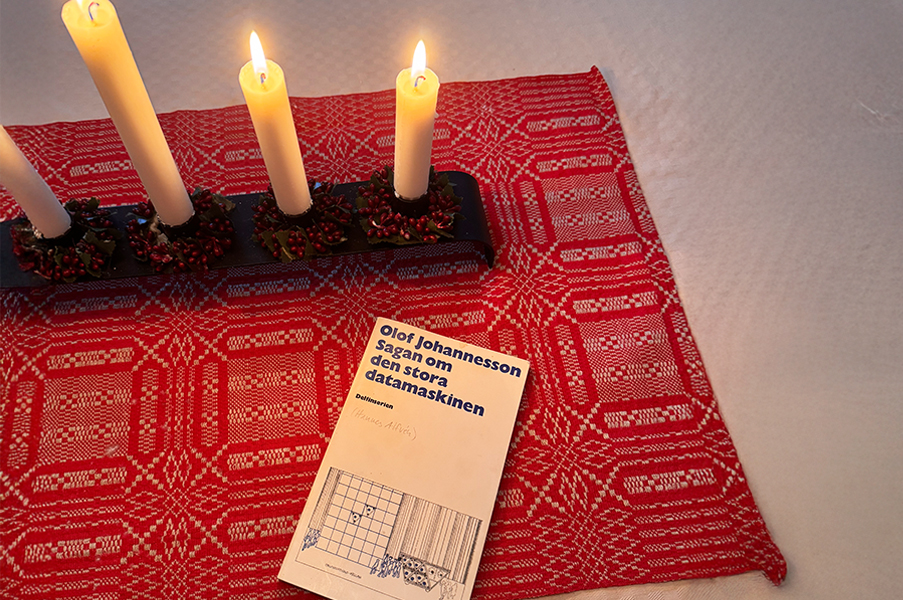
Why read a 60-year-old book about “data” this Christmas?
While we're unwrapping Christmas presents filled with smart gadgets and apps that "just want to optimize our lives a little more," it's perfect timing to pick up a little classic from 1966: The story of the big computer by Olof Johannesson (pseudonym for KTH professor and Nobel Prize winner Hannes Alfvén).
The book is not a thick brick but rather a relatively brief, dry and analytical tale told from a distant future, where the omniscient Big Computer looks back on us humans as a quaint but unnecessary step in evolution. A bit like horses after the arrival of the car: cute to have in the pasture, a leisure interest for some, but industrialized society rolls on without them.
Alfvén drives home how we humans always choose convenience: ”A little more efficient now, a little more flexible later…” – until we wake up and realize that we no longer control the system, but the system controls us. It doesn’t happen as a coup d’état in the form of a robot war à la Terminator, but in small, rational steps.
A neat example is teletotal – a small portable gadget that is ”basically a combination of a pay phone, radio and TV”. It keeps track of your location, your health and everything else to ”optimally plan society’s resources”. Does that sound familiar? Like a smartphone on steroids, with apps that track steps, heart rate and location – all for our own good, of course. And who doesn’t want to share? Well, they have something to hide…
Today, almost 60 years later, the book is eerily prophetic. Just like in Alfvén's saga: we streamline little by little, until we can no longer opt out, turn off or even fully understand the machinery. And then everything dies - but now I won't reveal any more of the plot.
As an IT veteran with over 25 years in the industry, I reflect on how what starts as voluntary solutions over time become mandatory systems or ones we can't do without.
“Better for whom?” Alfvén asks dryly.
Take NIS2, the EU's updated cybersecurity directive that Sweden is now implementing through a new cybersecurity law. The law forces service providers of critical importance to society, such as energy, healthcare, transport, water and digital infrastructure, to protect their IT systems against cyber threats. Well thought out, absolutely, and high time to strengthen security. But the irony in the shadow of the book: we are building large, complex systems that are becoming "too important to fail". One intrusion, one bug or one mistake - and large parts of society come to a standstill. Just like in Alfvén's saga, we are streamlining little by little, until we can no longer opt out, turn off or fully understand the machinery.
The key thing (for us humans) is that the services we have created and become dependent on must work. For us. And in order to be able to govern and control them, we must understand them.
So why read this particular book this Christmas? Because it's short, funny in that slightly dark way, and gives you something to talk about at Christmas dinner: "Imagine the day ChatGPT writes its own saga – about humanity?"”
Merry Christmas – and keep an eye on the teletotal in your pocket!
Latest articles


Insights
Latest articles
Omegapoint is a Microsoft Solutions Partner for Modern Work
How dangerous is it to let AI-based agents into your own systems?