AWS Manufacturing GenAI & Agentic Hackathon – from learning to an unexpected win
AWS Manufacturing GenAI & Agentic Hackathon – from learning to an unexpected win
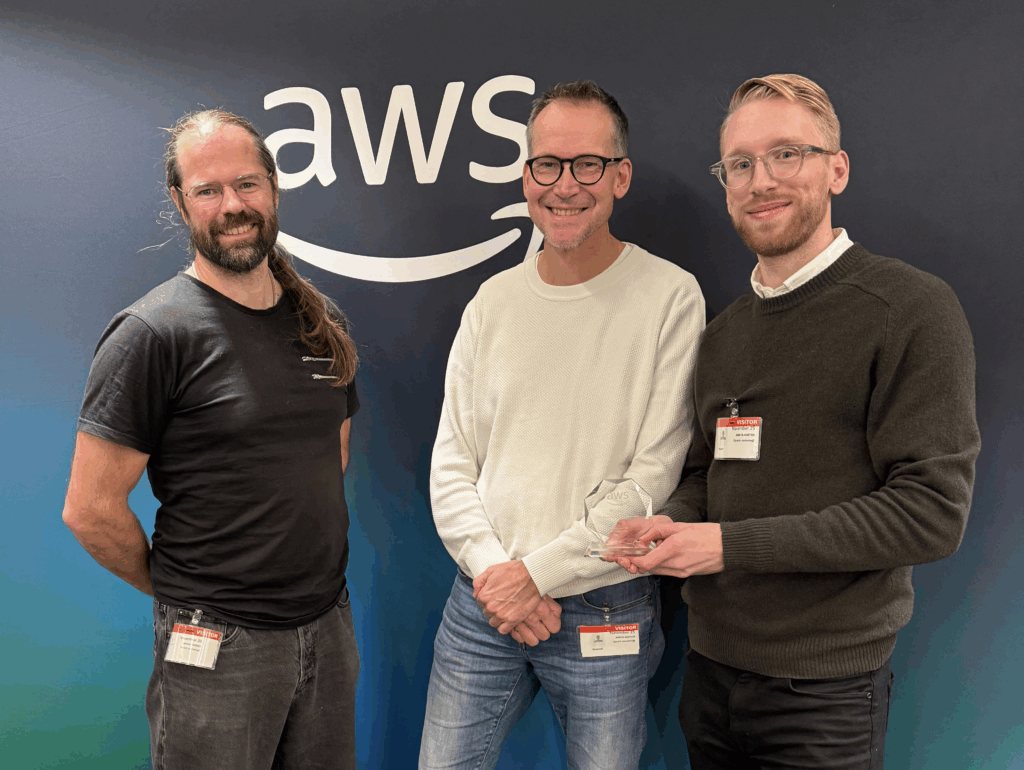
On November 25, AWS invited to a Hackathon to encourage experimentation at the interface between manufacturing and agentic AI.
The hackathon was based on a complete simulated wind turbine factory, with everything you can imagine: order backlog, warehouse, shift schedules, sensors on paint machines, curing ovens and a long list of IT and OT systems. In reality, this would have corresponded to ERP, workforce planning, SCADA in various flavors, MES and the rest of the industrial everyday life. AWS had made it unusually smooth by exposing everything via MCP servers, with both resources and tools in place.
The mission was formulated simply:
”Build something truly valuable with GenAI and agent-based architecture.”
That's where our part of the story begins.
We who participated from Omegapoint (Dan, Emanuel and Jesper) are not manufacturing people. We have worked with safety, architecture and operations in many different contexts, but factory logistics and OEE are not part of our home repertoire. That was also exactly why we went there: to learn, not to win anything.
Quite honestly, our attitude was:
”Let's soak up knowledge, test ideas and see what happens.”
We were caught up early on in a problem that felt both concrete and a bit fun: detecting and managing production disruptions on critical machines. Roughly:
”If a ball bearing overheats at 4:16 a.m. on a Thursday night – how can AI agents help the factory get back up and running quickly by using as much information as possible to make well-considered decisions?”
From there, three generations of work followed.
Generation 1: Rule-based repair planner
The first variant was a pure repair agent that built a plan for how to get the machine up and running as quickly as possible. It took into account skills, schedules, on-call, spare parts, cost considerations and sign-off. We even mocked up an MCP server that ”sent mail” via S3.
It worked, but was basically a rules engine. No real reasoning.
So we dropped it and started over.
Generation 2: LLM-driven, but too broad
The next attempt was LLM-based and significantly more ambitious. We included order backlog, customer impact and alternative production flows. It worked, but in practice it was mostly a Python script that collected all the data and put it all into a giant prompt with the instruction:
”"Do something smart with this."”
Technically prettier. Architecturally too sprawling. And certainly not the kind of AI we like. For us, “AI should be able to do something smart” is an anti-pattern.
We knew we could do better.
Generation 3: An ecosystem of seven specialized agents
The third generation was the one that landed right. We built an ecosystem of seven specialized agents, each with its own area of expertise and its own set of MCP servers from which it pulled information.
The basic idea was simple:
”Gather experts in a room and let them reason their way to a solution.”
Example:
- a technical expert who knows which repairman can do which repairs and is aware of shifts and working hours regulations
- a supply chain expert who has an eye on spare parts and how we can possibly get back any that are missing
- a customer impact agent for which orders would be affected if production is delayed
- and similar roles for planning, finance and production planning etc.
The seventh agent, Failure Crisis Coordinator, kept the reasoning together and passed around updated context until the group converged. In our test case, this happened after five rounds.
The felt like real agent architecture and not just an LLM that tried to chew too much at once.
The presentation
We hadn't really planned on presenting. We had gone there to learn, not compete. At one point we even said:
”"Uh, we'll let the others compete. We'll do our thing."”
But once the third generation was working, we felt it would be a shame not to show it. So we put together some footage, showed some live output, and took five minutes on stage.
And then… we won.
It still feels a little surreal.
We came there to learn.
We built something we thought was exciting.
And apparently that was enough all the way.
Latest articles





Insights
Latest articles
Omegapoint is a Microsoft Solutions Partner for Modern Work

How dangerous is it to let AI-based agents into your own systems?